CryptoGuestPosts.com: Hot U.S. Inflation Data Drives $610 Million Crypto ETF Outflows

CryptoGuestPosts.com: Hot U.S. Inflation Data Drives $610 Million Crypto ETF Outflows
// Price

Reading time: 3 min

Published: Oct 18, 2026 at 21:55
Updated: Oct 18, 2026 at 22:09

Despite macro turbulence fueled by higher-than-expected U.S. inflation metrics, the cryptocurrency market is demonstrating underlying resilience

Bitcoin closed out the week hovering near $81,700, absorbingly withstanding rate-hike pressures while Ethereum and altcoins experienced steeper localized pullbacks.

CPI Spikes and Re-priced Fed Expectations

The core catalyst behind recent market caution stems from dual inflation shocks across U.S. macroeconomic indicators. September Consumer Price Index (CPI) metrics printed at 3.7%, while Producer Price Index (PPI) figures jumped 6.3% year-over-year, marking the sharpest wholesale expansion in four years, primarily driven by rising energy costs.

The hot inflation print caused money markets to double the implied probability of an upcoming Federal Reserve rate hike on October 28.

Now, despite briefly dipping to $80,617 following the data release, Bitcoin rebounded sharply toward $82,300 before settling around $81,700, finishing the volatile week down less than 1% overall.
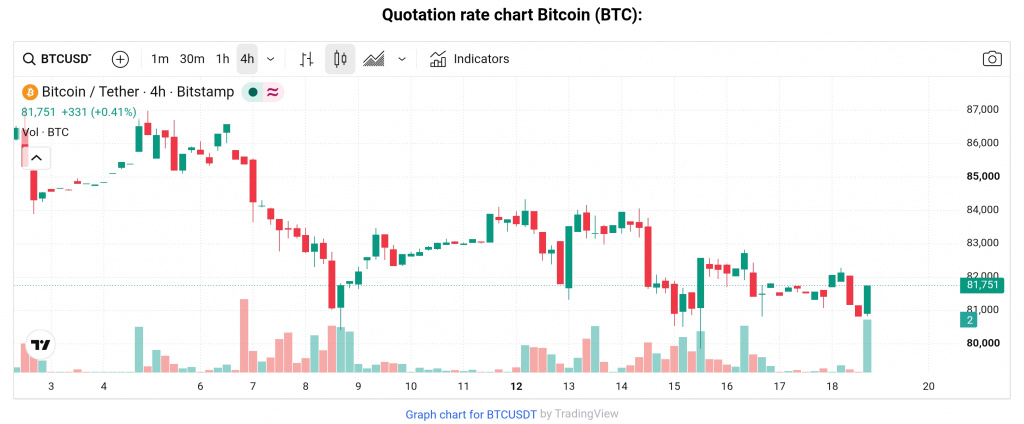
BTC price, Oct 18, 2026

Ethereum Funds Lead Capital Withdrawals

Institutional allocators adopted a defensive stance over the five-day trading session, resulting in $610.7 million in net outflows across U.S. spot crypto ETFs.

In a notable shift, Ethereum spot products experienced heavier institutional redemptions than Bitcoin. Outflows were dominated by BlackRock’s spot Ethereum ETF (ETHA), which shed nearly $299 million, accounting for over 90% of total category redemptions.
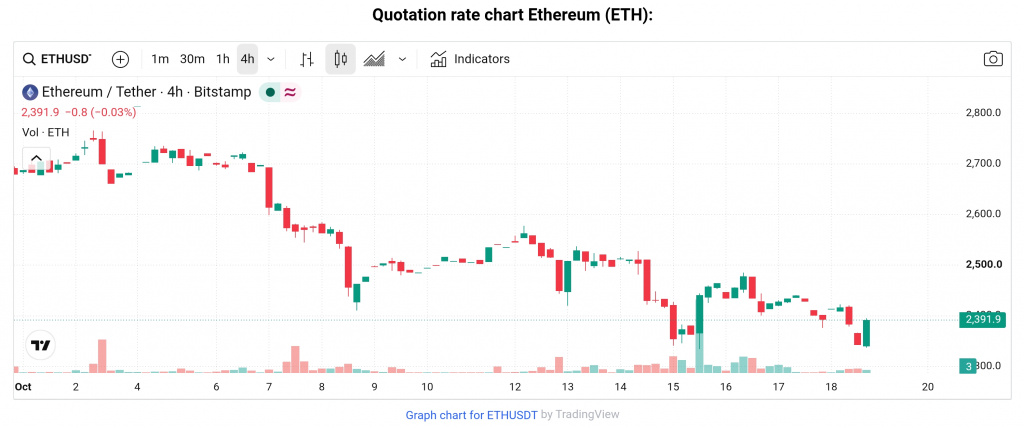
ETH price, Oct 18, 2026

As Bitcoin's market dominance hovered near multi-month highs, altcoins bore the brunt of the risk-off sentiment. Ethereum slid toward $2,390 (down 6.6% on peak down-days), while Solana and XRP registered sharp weekly drops of roughly 6%.
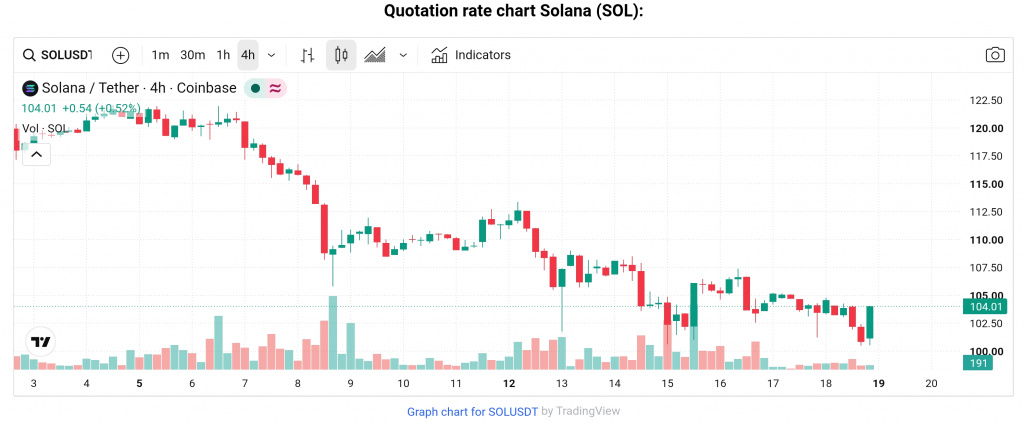
Solana price, Oct 18, 2026

Derivatives Balance and Key Support Levels

Market leverage metrics indicate that the recent flush has cooled overheated perpetual funding rates. With the Crypto Fear & Greed Index resetting to 55 (Neutral/Greed), traders enter the week focused on whether $80,000 will continue to act as a structural floor while upcoming corporate earnings and regulatory deadlines dictate Q4 momentum.

Disclaimer. The data provided is collected by the author and is not sponsored by any company or token developer. This is not a recommendation to buy or sell cryptocurrency and should not be viewed as an endorsement by CryptoGuestPosts. Readers should do their research before investing in funds. Brought from CryptoGuestPosts.com.


Macro Shock and ETF Outflows Trigger Massive $1 Billion Liquidations as Bitcoin Dips Near $81,000

Macro Shock and ETF Outflows Trigger Massive $1 Billion Liquidations as Bitcoin Dips Near $81,000
// Price

Reading time: 2 min

Published: Oct 08, 2026 at 22:05
Updated: Oct 08, 2026 at 23:14

The immediate priority for bulls is defending the $80,000 support

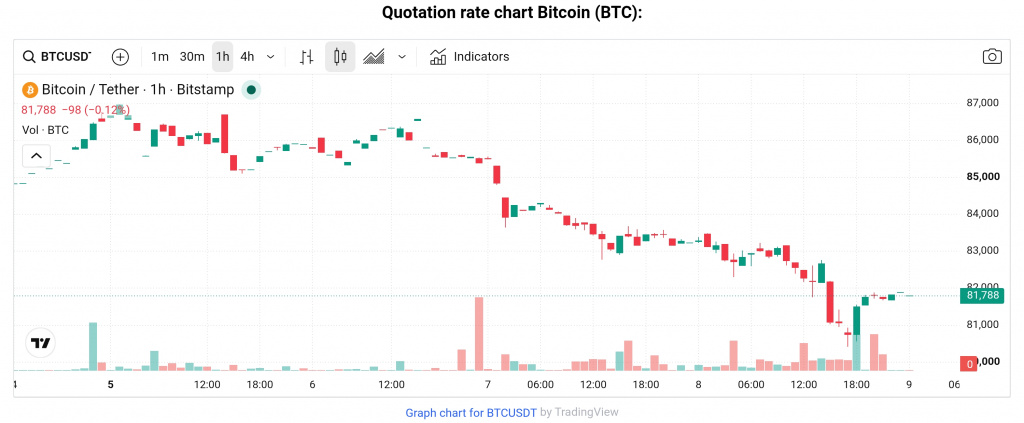
The crypto market has suffered a sharp risk-off reversal, plunging sharply as a combination of hawkish macroeconomic data, technical liquidations, and heavy spot ETF outflows wiped out over $1 billion in derivatives positions across a brutal 24-hour window.

Bitcoin dropped toward the $81,000 threshold, dragging major altcoins and Ethereum down significantly in tandem.

BTC price, Oct 8, 2026

October Meltdown

The sudden market downturn broke key technical support levels, catching leveraged traders off guard and triggering a severe cascade of forced position closures.

According to CoinGlass and market tracking data, total crypto market liquidations topped $1.16 billion, with over 90% of the wiped-out positions consisting of over-leveraged long bets. Bitcoin accounted for roughly $209 million of the liquidations, while Ethereum saw $87 million flushed out.

Moreover, for much of recent months, U.S. spot Bitcoin ETFs acted as the primary structural buyers absorbing market dips. That dynamic inverted dramatically as institutional funds logged massive net outflows, with U.S. spot Bitcoin ETFs shedding nearly $485 million in a single session.

Key Support Levels to Watch

Following the swift descent, Bitcoin dipped to an intraday low near $80,427 before stabilizing around the $81,000 to $81,800 range. Ethereum experienced an even heavier correction, sliding toward $2,432 amid a broader 9% weekly contraction.

Analysts note that while the aggressive leverage flush has successfully cooled overheated market sentiment, the immediate priority for bulls is defending the $80,000 support floor. Sustained institutional re-entry via spot products will be critical to determine whether this pullback represents a temporary macro-driven correction or a deeper shift in fourth-quarter market momentum.

Disclaimer. This data are the personal opinions of the author. The data provided is collected by the author and is not sponsored by any company or token developer. This is not a recommendation to buy or sell cryptocurrency and should not be viewed as an endorsement by Coinidol. Readers should do their research before investing in funds.

Kyeson Blake Utley Launches GhostKey Development, a Texas Firm for Post-Quantum Cryptography and In-House Penetration Testing

Kyeson Blake Utley Launches GhostKey Development, a Texas Firm for Post-Quantum Cryptography and In-House Penetration Testing

Kyeson Blake Utley has launched GhostKey Development, a Texas security engineering firm that helps companies migrate to post-quantum cryptography, build and audit cryptocurrency systems, and run full-scope penetration tests performed entirely in-house. The launch includes a free browser-based passphrase generator and a white paper by Utley on preparing for NIST's 2030 and 2035 post-quantum deadlines. [PR.com]...

Bitget Breach Shakes Custody Confidence as Zcash Reclaims Privacy Spotlight in Late September 2026

Bitget Breach Shakes Custody Confidence as Zcash Reclaims Privacy Spotlight in Late September 2026
// News

Reading time: 3 min

Published: Sep 27, 2026 at 11:20
Updated: Sep 27, 2026 at 12:29

While Bitcoin consolidates above the $84,000 threshold on track for a historic third-quarter winning streak, the industry has been forced to confront structural vulnerabilities following a high-profile security breach.

The primary focal point across the blockchain sector is the reported security breach affecting major cryptocurrency exchange Bitget. Independent security tracking and on-chain intelligence place estimated losses between $351.6 million and $387.5 million, making it one of the largest centralized custody incidents in recent years.

However, preliminary forensic reports indicate that attackers compromised core wallet-backend infrastructure and successfully spoofed transaction data. Crucially, Bitget reported that cold storage reserves and overall customer funds remained largely isolated and protected.

Stability was partially maintained as major stablecoin issuers stepped in; Circle and Tether swiftly froze a combined $318,000 in hacker-controlled addresses. However, tracking mechanisms highlighted complications as portions of stolen tokens, including roughly $83 million in XRP, began moving through decentralized channels that lack native-asset freeze functions.

The incident has reignited urgent industry-wide debates regarding centralized exchange (CEX) transparency, the limits of internal insurance funds, and the growing urgency for non-custodial self-sovereignty solutions.

Zcash Soars as Institutional Access Diverges Privacy Sectors

Away from exchange-level security turbulence, the privacy coin sector has experienced a dramatic market rotation, led by a massive resurgence in Zcash (ZEC).

Zcash recorded an explosive monthly rally, nearly quadrupling from its summer floor with gains exceeding 96% over a 30-day window. Market analysts
attribute Zcash’s outperformance to structural tailwinds that its historical competitors (most notably Monero) have lost. With nearly $1 billion in U.S. spot exchange-traded products and regulated European fund access, Zcash has successfully bridged institutional compliance requirements with zero-knowledge (ZK) privacy mechanics.

Resilience Meets Scrutiny

Despite the friction introduced by the Bitget exploit and lingering macroeconomic headwinds, the broader market continues to display underlying structural strength. U.S. spot Bitcoin and Ethereum ETFs have notched multi-day net inflow streaks, recovering billions from earlier mid-year outflows.

As September closes, institutional participants and retail traders alike are balancing optimism over expanding Layer-1 speed upgrades — such as Solana's Alpenglow testnet targeting 150-millisecond finality — against a renewed demand for airtight custody practices.

Disclaimer. This analysis and forecast are the personal opinions of the author. The data provided is collected by the author and is not sponsored by any company or token developer. This is not a recommendation to buy or sell cryptocurrency and should not be viewed as an endorsement by CryptoGuestPosts. Readers should do their research before investing in funds. 

U.S. Senate Fails to Advance CLARITY Act Amid Ethics Deadlocks, Triggering Sudden Crypto Sell-Off

U.S. Senate Fails to Advance CLARITY Act Amid Ethics Deadlocks, Triggering Sudden Crypto Sell-Off

Published: Sep 16, 2026 at 20:43
Updated: Sep 16, 2026 at 21:54

The market faced a sharp reality check as a long-anticipated legislative milestone suffered a major setback

The Digital Asset Market Clarity Act (CLARITY Act) officially failed to secure the required 60 votes during a procedural vote in the U.S. Senate, halting months of bipartisan negotiations and dealing a severe blow to efforts to establish a comprehensive federal regulatory framework for the U.S. crypto industry.

For over a year and a half, lawmakers and industry leaders worked to craft a unified system to classify and regulate cryptocurrencies. However, the bill collapsed at the final procedural hurdle due to intense political gridlock over government ethics provisions and potential conflicts of interest.

Senate Democrats heavily pushed to address corruption risks and guardrails surrounding executive involvement in digital asset ventures, while Republicans voiced strong concerns over imposing restrictive oversight limitations.

Immediate Macro Pressures

The legislative failure sent immediate shockwaves through the cryptocurrency market, compounding broader macroeconomic friction ahead of the Federal Reserve’s interest-rate decision.

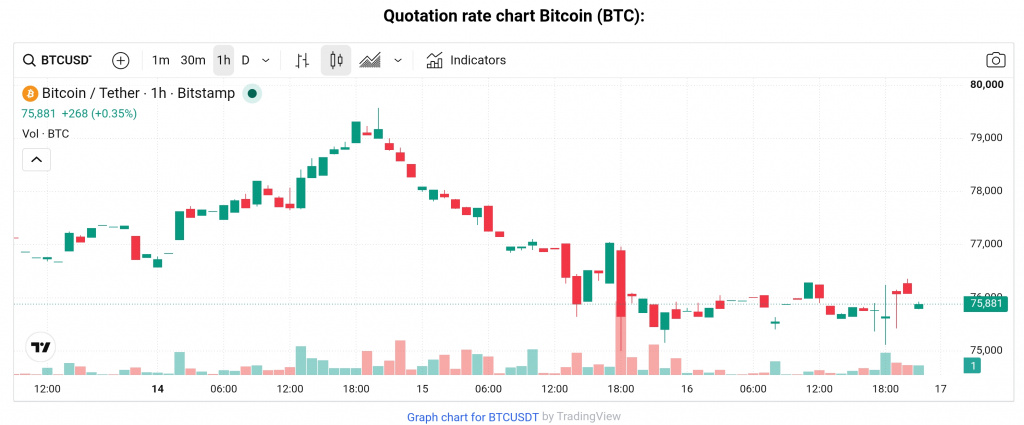
Bitcoin tumbled from recent highs, sliding toward the $75,500–$76,000 support range, while Ethereum experienced a parallel 4.6% retreat toward the $2,400 level.

BTC price, Oct 17, 2026

Prolonged Regulatory Uncertainty

With the CLARITY Act stalled, institutional and retail market participants are left navigating a fragmented regulatory landscape. Analysts warn that until lawmakers can bridge ethical divides, domestic crypto development will continue to face institutional hesitation and prolonged compliance ambiguity.

Disclaimer. The data provided is collected by the author and is not sponsored by any company or token developer. This is not a recommendation to buy or sell cryptocurrency and should not be viewed as an endorsement by CryptoGuestPosts. Readers should do their research before investing in funds. Brought from CryptoGuestPosts.

MSCI Considers Index Exclusion for Corporate Bitcoin Treasuries in High-Stakes September

MSCI Considers Index Exclusion for Corporate Bitcoin Treasuries in High-Stakes September
// News

Reading time: 2 min

Published: Sep 03, 2026 at 20:06
Updated: Sep 03, 2026 at 21:14

Corporate treasury advocates argue

MSCI opens a critical consultation period that could fundamentally reshape how publicly traded Bitcoin treasury companies are viewed by global institutional funds.

At the center of the debate is an upcoming structural review by MSCI regarding companies that hold massive reserves of cryptocurrencies. MSCI is consulting on rules that would classify certain firms, specifically those whose primary business operations are overshadowed by massive digital asset holdings, such as Strategy (formerly MicroStrategy) and Metaplanet, as "non-operating" entities.

Because inclusion in major MSCI indices drives billions of dollars in passive fund allocation from institutional pension funds, mutual funds, and ETFs, this classification carries massive financial weight.

Key Deadlines

The consultation window closes on September 30, 2026, with official results slated for release on October 16, 2026. Any formal changes resulting from this review would take effect during the November 2026 index review.

Corporate treasury advocates argue that holding Bitcoin functions as an innovative corporate reserve asset strategy rather than turning a functioning business into a passive shell.

This review highlights the growing friction between legacy financial index providers and the aggressive corporate adoption of Bitcoin. As public companies increasingly model their balance sheets around crypto reserves, institutional gatekeepers are forced to decide whether standard market indices can accommodate digital-native treasuries.

Disclaimer. The data provided is collected by the author and is not sponsored by any company or token developer. This is not a recommendation to buy or sell cryptocurrency and should not be viewed as an endorsement by CryptoGuestPosts. Readers should do their research before investing in funds. Brought from CryptoGuestPosts.

ADAM Aerospace Acquires Position in Iron Thicket to Advance Mission-Assured Software and Governed AI

ADAM Aerospace Acquires Position in Iron Thicket to Advance Mission-Assured Software and Governed AI

ADAM Aerospace has acquired a significant equity position in Iron Thicket, expanding its trusted-data capabilities into governed software, AI assurance, and decision provenance. The relationship strengthens U.S. sovereign defense and space technologies by creating an end-to-end trust architecture for verified data, accountable AI, auditable software, and provable mission decisions. [PR.com]...

Major Fintech Giants Form the “Agentic Payments Alliance” to Standardize AI Crypto Rails

Major Fintech Giants Form the "Agentic Payments Alliance" to Standardize AI Crypto Rails
// News

Reading time: 2 min

Published: Aug 27, 2026 at 22:04
Updated: Aug 27, 2026 at 22:11

The foundational plumbing for the next era of digital commerce

Traditional payment heavyweights and Web3 infrastructure providers have officially banded together to tackle a looming technical hurdle: automated financial settlements executed entirely by artificial intelligence.

As autonomous AI agents evolve from passive data assistants into active financial actors capable of managing portfolios and executing smart contracts, they have outpaced existing financial infrastructure. To prevent systemic fragmentation, industry leaders have established the Agentic Payments Alliance (APA).

The primary objective of the alliance is to build a unified framework for AI-initiated transactions. Because traditional payment rails require manual human authentication, two-factor checks, and static account identifiers, they are fundamentally unsuited for high-frequency, programmatic micro-payments executed by machine learning algorithms.

By combining blockchain's programmable settlement layers with standardized identification and authorization protocols, the APA aims to establish safe, predictable rails where AI agents can autonomously pay for APIs, cloud compute, and digital data services using stablecoins.

The Future of Cryptocurrencies

The formation of the alliance underscores a critical reality: the long-term utility of cryptocurrencies is rapidly shifting toward automated, machine-to-machine economies. Now, without universal standards, autonomous AI transactions run the risk of triggering false fraud alerts, execution loops, or irreversible smart-contract errors. The APA is drafting unified verification rules to establish trust boundaries between algorithms and financial accounts.

Institutional analysis highlights that programmatic machine economies prefer stablecoins over volatile digital assets due to predictable pricing and instant on-chain finality. Initiatives like the APA provide the necessary compliance and technical framework to scale these operations globally.

Disclaimer. The data provided is collected by the author and is not sponsored by any company or token developer. This is not a recommendation to buy or sell cryptocurrency and should not be viewed as an endorsement by CryptoGuestPosts. Readers should do their research before investing in funds. Brought from CryptoGuestPosts.